How Does Elegance Show Itself at the Table?
Refinement, Courtesy and Hospitality at the Modern Table

Good table manners are not about displaying rules; they're about making everyone at the table feel comfortable, valued, and warmly welcomed.
An elegant table isn't created only by beautiful china, correctly placed cutlery, or a flawless tablecloth. True elegance begins once people sit down at the table.
Not interrupting a guest, treating staff with respect during service, not making a big deal out of a small mishap, not insisting on second helpings, not letting the phone take priority over conversation…
None of these are showy gestures. Yet more often than not, it's exactly these small details that determine how a table is remembered.
In our last issue, we covered the basic rules of the table. This time, we're going one step further, looking less at what's on the table and more at the behaviour around it.
SITTING DOWN AT THE TABLE IS ALSO A COURTESY
At a dinner, it's elegant to wait for the host's guidance rather than settling into a seat before everyone else. If a seating arrangement has been set, don't switch places; if it hasn't, give others the chance to settle in comfortably too.
Not pulling your chair too far from the table, not disturbing those around you as you sit down, and not spreading personal belongings across the table are small but important details.
Keeping bags, phones, keys and glasses cases from taking over the dining space makes the table both tidier and more comfortable.
And perhaps most importantly:
The moment we sit down at the table, we join not only the meal, but the time we're about to share together.
THE QUIET LANGUAGE OF THE NAPKIN
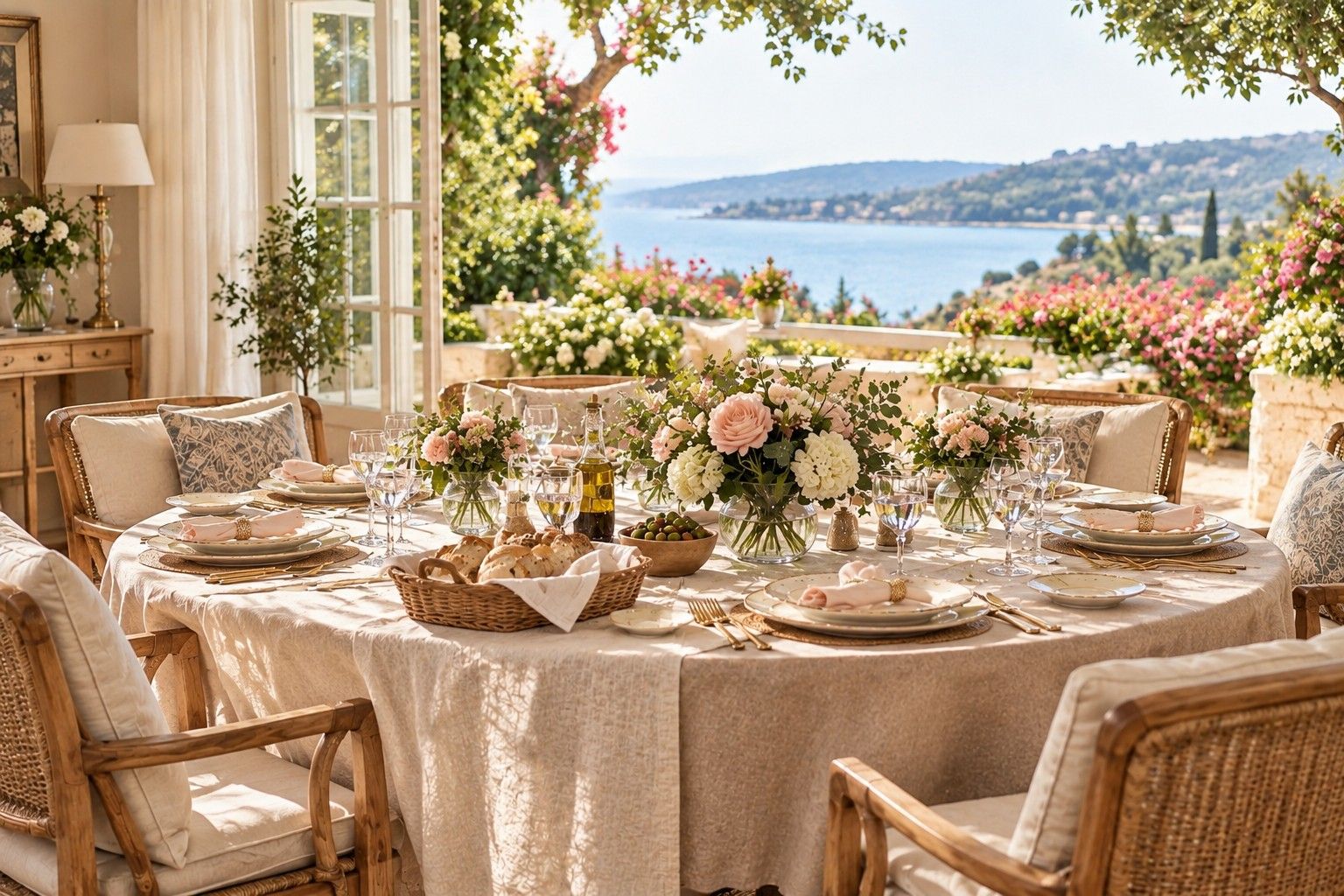
A table set in a glass conservatory overlooking the Mediterranean.
The napkin is one of the simplest pieces on the table; yet its use remains a source of hesitation for many.
Once seated, as the meal is about to begin, the cloth napkin is gently unfolded and placed over the lap. Larger napkins can often be used folded in half rather than fully opened.
The napkin's job is not to wipe the face or the plate. It's used, when needed, with a light touch at the corners of the mouth.
Removing excess lipstick before the meal can also reduce visible marks left on glasses.
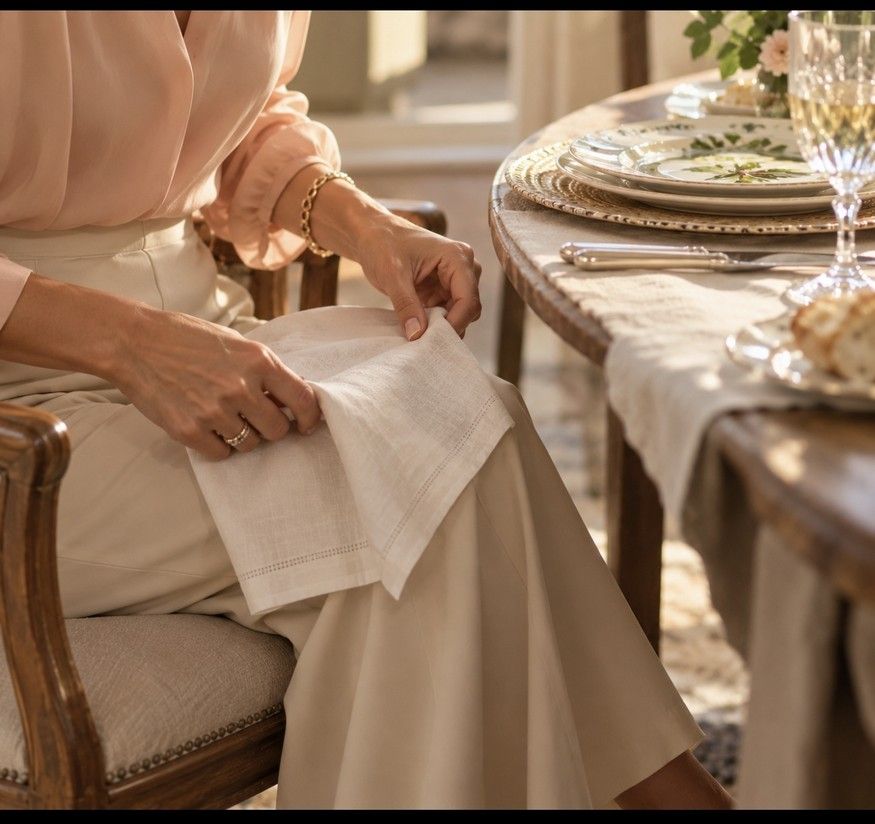
Gently placing a cloth napkin on the lap.
If you need to step away from the table briefly during the meal, some traditional etiquette sources suggest leaving the napkin on the chair, though practice can vary by culture and setting. Today, the clean and practical approach is to leave the napkin loosely and neatly to the left of your place setting.
Once the meal has fully ended, there's no need to try to refold the napkin back into its original shape. It's left loosely and lightly to the left of the plate.
Elegance lies not in refolding the napkin like origami, but in being able to use it quietly and naturally.
CONVERSATION IS THE TABLE'S INVISIBLE SERVICE

Conversation at the table — leaving room for everyone to speak.
A well-prepared meal brings people to the table; good conversation is what keeps them there.
The most basic rule of table conversation is simple:
Leave room for everyone to speak. A table where one person talks constantly while everyone else only listens is never truly a good gathering, no matter how beautifully it's set.
Ask questions. Listen. Gently draw in those who are speaking less. But never force anyone to speak.
Not speaking with food in your mouth isn't just a classic rule of etiquette; it's also part of the basic respect shown to the person across from you. If a question comes your way at exactly that moment, you can finish what you're eating before answering, rather than rushing to reply.
Holding your fork or knife in the air while talking at length, or gesturing with them, doesn't look good either. If the conversation is going to run long, it's more elegant to rest your cutlery on the plate.
WHERE SHOULD A PHONE SIT AT THE TABLE?
Out of sight, if at all possible.
This is perhaps one of the newest rules of etiquette at the modern table.
Placing a phone right next to your plate — even face-down — can unintentionally send the message that "my attention could drift away at any moment."
Especially at a small dinner, keeping the phone in a bag or pocket changes the quality of the conversation.
If you're expecting an important call, it's enough to mention this briefly to the table beforehand:
"I'm expecting an important call — if it comes, I may need to step away for a moment." When the call comes, the most elegant solution, if possible, is to step away from the table to talk, rather than turning everyone else at the table into an audience for your conversation.
If you want to take a photo, it's important not to keep the whole table waiting too long.
Chasing the perfect shot while the food goes cold can defeat the whole purpose of a beautiful table.
OFFERING FOOD AND INSISTING ARE NOT THE SAME THING
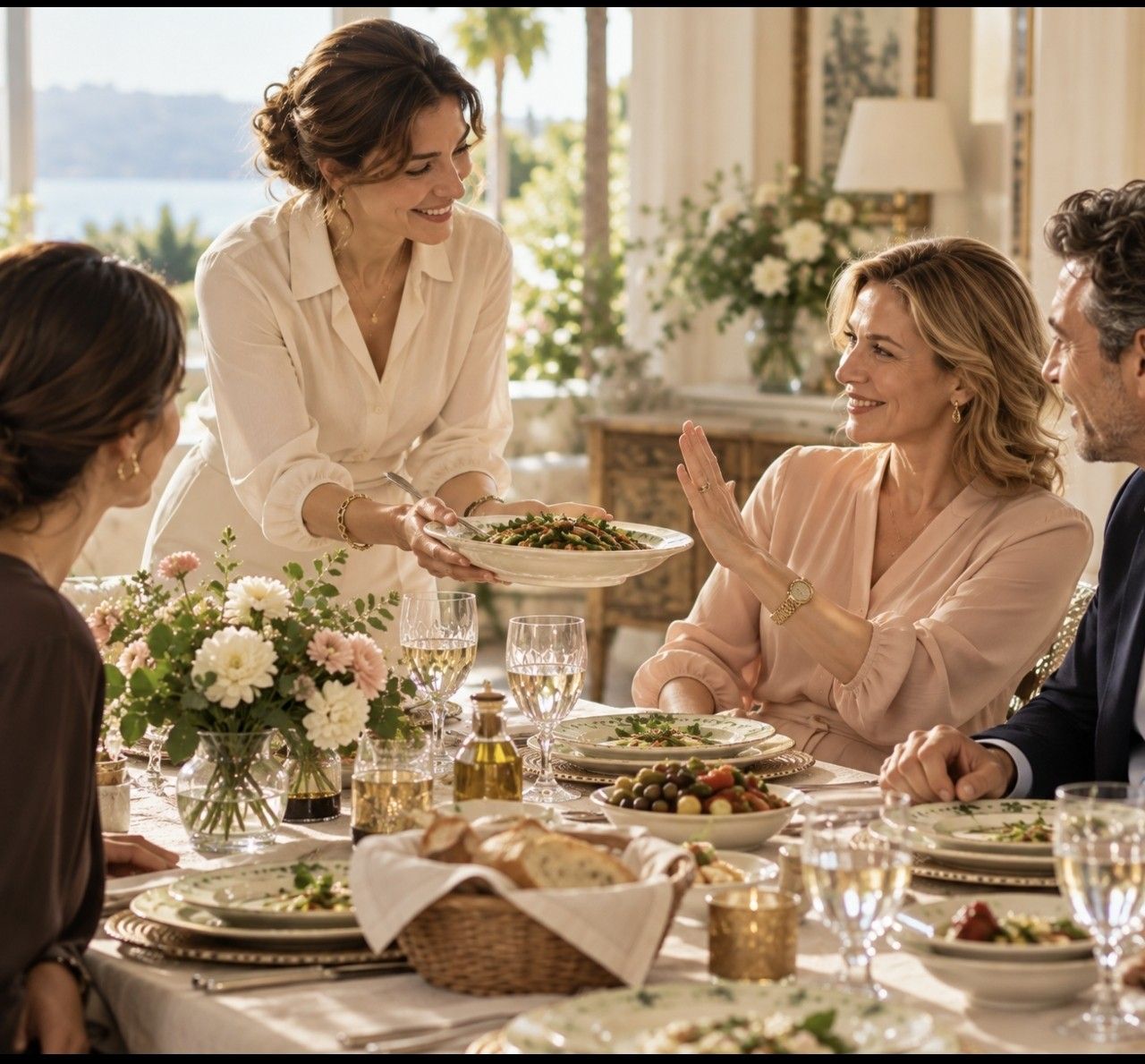
Offering food and insisting on it are not the same thing.
"Would you like a little more?" A gracious thing for a host to say.
"No, thank you." A gracious response from a guest.
And, more often than not, the conversation should end there.
Continually refilling a guest's plate, or insisting with phrases like "You haven't eaten anything," "You really must finish this," or "Just one more spoonful" — however well-intentioned — can make the other person uncomfortable.
People's appetites, health conditions, preferences and diets can all differ. They are never obliged to explain any of this at the table.
As a guest, too, declining an offer doesn't require a long explanation.
"Thank you so much, it was truly lovely, but that's plenty for me." is polite enough in most situations.
THE GRACIOUS HOST'S RULE
Offer once. Respect the answer.
Hospitality means knowing how to respect boundaries just as much as it means keeping plates full.
DIFFICULT FOODS, SIMPLE RULES
When certain foods arrive at the table, we may pause for a moment and think, "How am I supposed to eat this?"
A few simple rules are usually enough.
Bread
Bread from your personal bread plate can be broken into small bite-sized pieces as needed, rather than bitten from a large piece. If butter is being served, spreading it onto the small piece you're about to eat is more in keeping with classic table etiquette.
Olives
If a pitted olive has been brought to the mouth by hand, the pit can generally be removed the same way, discreetly. If it was eaten with a fork, it's preferable to bring the pit back onto the fork in a similarly controlled way.
The main rule is simply not to turn the pit into an attention-drawing gesture at the table.
Spaghetti
A small amount of spaghetti is taken onto the fork and twirled against the edge of the plate or in the available space. Avoiding a very large mound of pasta, and not pulling long strands toward the mouth, gives a more elegant look.
In Italian tradition, using a spoon for spaghetti is not generally considered necessary.
Lemon
When squeezing a lemon slice or wedge over food, take care that the juice doesn't splash nearby. If needed, you can shield it lightly with your other hand.
Sauce
Wiping the plate completely clean with bread may not be considered appropriate at formal tables. At more casual tables, culture and setting are the deciding factor.
And here's an important detail:
Table etiquette can vary by culture. What feels natural in one country may be unusual in another. At an international table, elegance is sometimes less about applying a rule by rote, and more about being able to observe the culture you find yourself in.
WHEN SOMETHING GOES WRONG…
A glass has tipped over.
A fork has fallen to the floor.
The waiter has brought the wrong plate.
Sauce has spilled onto the food.
These are the moments when etiquette is truly tested.
A small mishap shouldn't be turned into a big event at the table.
If your fork falls to the floor at a restaurant, you can simply ask the server for a new one rather than bending down to look for it under the table.
If a drink spills, the important thing is to have it cleaned up calmly, asking for help if needed, without creating a fuss.
Perhaps more important than any other rule is not embarrassing someone else when they make a mistake.
Because true elegance isn't flawlessness.
It's being able to put others at ease when a flaw appears.
ELEGANCE AT THE RESTAURANT
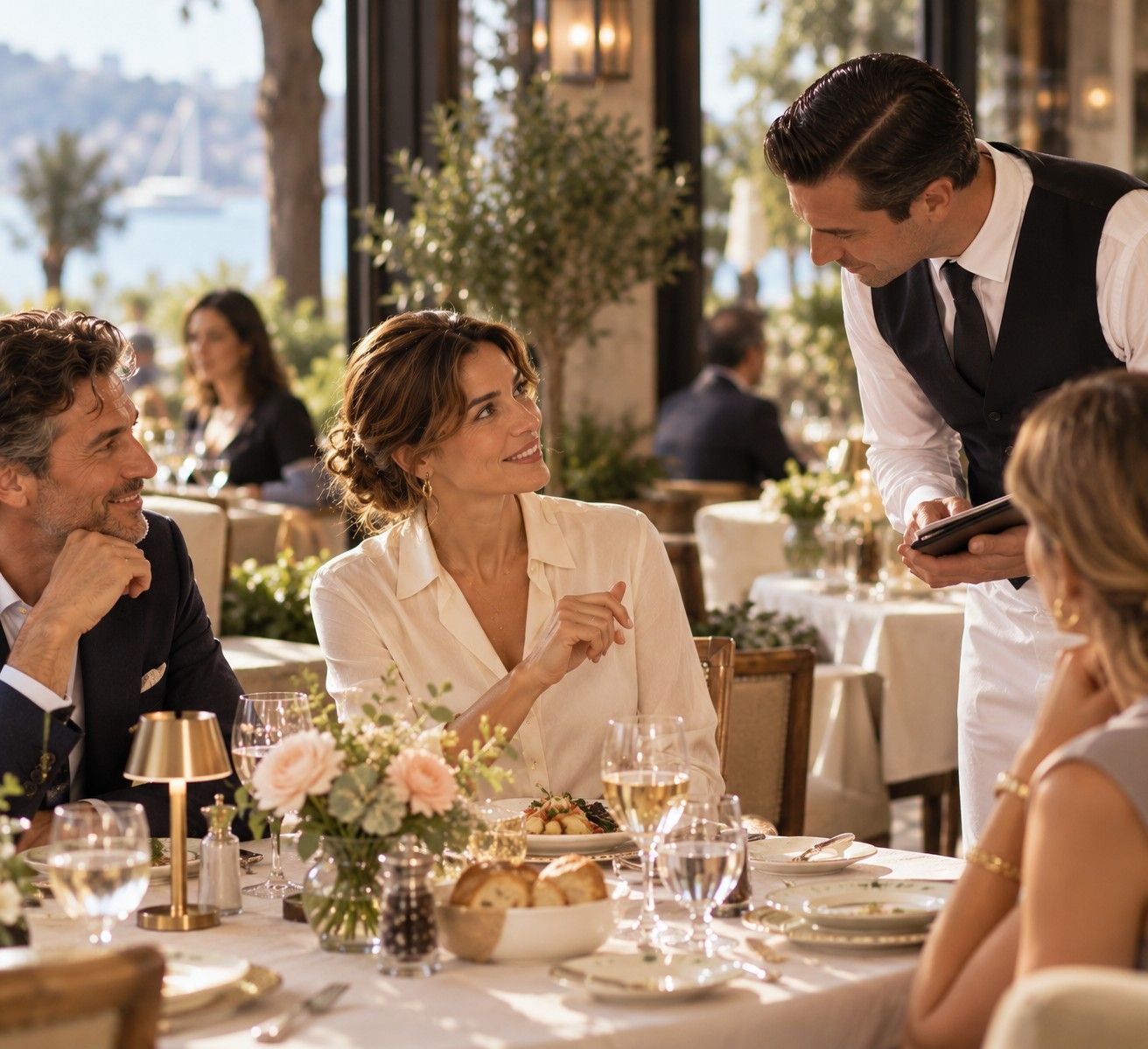
Elegance at the restaurant — courtesy applies on both sides of the table.
Courtesy Applies on Both Sides of the Table
Good table manners aren't only for dinners at home.
How we treat staff at a restaurant is also part of our table culture.
When you need to get a server's attention, making eye contact or speaking up gently at a suitable moment is enough. Snapping your fingers, calling out loudly, or using a dismissive tone is never elegant.
If there's a problem with your order, there's no need to hesitate to mention it.
But the aim of a complaint should be to resolve the issue, not to make someone feel small.
For example, the sentence:
"Excuse me, I believe my order was different — could we check on that?" is enough in most situations.
Being polite doesn't mean giving up what you're owed.
Elegance is being able to express what you need without wounding the other person's dignity.
WHEN THE BILL ARRIVES
Especially at a hosted dinner, one of the most awkward moments can be when the bill arrives at the table.
If the person who invited everyone wants to take care of the bill, they should do so as naturally and unobtrusively as possible.
A guest may offer to contribute once. If the host has made it clear they invited everyone and will be paying, a prolonged "I'll pay — no, I will" struggle doesn't add any elegance to the moment.
On the other hand, if splitting the bill among friends has been the plan, it's more comfortable for everyone if this is made clear beforehand, ideally before ordering, or in a natural way.
Talking about money isn't shameful.
Talking about money in a way that embarrasses others isn't pleasant.
THE HOST'S INVISIBLE ELEGANCE
A good host isn't simply someone who prepares a beautiful meal.
They're the one who notices the rhythm of the table.
They see when a guest's glass is empty, but don't hover over it. They don't pressure someone who doesn't want to eat. They gently draw in someone who has fallen out of the conversation. When a guest uses the wrong fork, they feel no need to correct it.
And most importantly, they never let their guests feel as though they're being tested.
Because the purpose of etiquette is not to set people apart from one another.
Good manners exist to make living together easier.
7 SMALL THINGS NEVER TO DO AT THE TABLE
- Placing your phone at the centre of the table. Give your attention to the people at the table.
- Commenting on someone else's plate. Phrases like "Is that all you're eating?" or "Are you going to finish all of that?" are unnecessary.
- Snapping your fingers at service staff. Courtesy isn't reserved only for guests.
- Pressuring someone to eat or drink. Offer; respect the answer.
- Speaking with food in your mouth. Waiting a few seconds is enough.
- Belittling someone else's choice. What someone orders to eat, drink, or how they choose to eat should never be a subject of criticism at the table.
- Turning a small mistake into a big issue. Sometimes the most elegant gesture is simply carrying on without making a big deal of it.
A NOTE FROM ZARİF YAŞAM
We can't tell someone's table manners simply from which hand they hold their fork with.
Perhaps the real sign is how they thank the person serving them.
Perhaps it's how they ease the embarrassment of someone who has accidentally knocked over their glass.
Perhaps it's politely declining a third helping, or not questioning a guest's "no" a second time.
A flawless table can make for beautiful photographs.
But it's how people make each other feel at that table that creates beautiful memories.
"Table etiquette is not about knowing which fork to use before anything else — it's about making the people around you feel at ease." — Zarif Yaşam