The Mark September Leaves on the Skin
Summer leaves behind a kind of tiredness in the skin that's just as real as the heat of the sun, even if it's less visible.
Months spent between sun, salt water, chlorine, sweat and air conditioning quietly wear down the skin's barrier, moisture balance, and tone. By the time September arrives, what's usually noticed isn't a sudden change in the skin, but an accumulation of small fatigues.
Our aim in this section isn't to alarm the skin or overwhelm it with a long list of products. We follow the same order under every heading: first understanding what's actually happening to the skin, then looking at what can be done, and, where relevant, noting when professional support might come into play.
Elegance shows itself here too: not by forcing the skin or rushing it, but by giving it the right thing at the right time.

Real skin after summer: in need of rest, natural, and beautiful.
1 · What Summer Leaves on the Skin
The effect summer has on the skin doesn't come from a single cause — it's the sum of several factors layered on top of one another.
The sun's ultraviolet rays can both dry out the skin's upper layers and disrupt melanin production. Chlorine and salt water, from frequent swimming, leave a drying effect that thins the skin's natural oil layer. Heavy sweating can create conditions for clogged pores and increased sensitivity. And hours spent in air-conditioned spaces lower the humidity in the air, causing the skin to lose its own moisture more quickly.
The result of these factors is usually gathered under four headings: dryness, sensitivity, dullness, and uneven tone.
None of these is concerning on its own. But layered together, the skin enters September looking as though it "needs to rest."
In September, the skin's first task in skincare isn't adding something new — it's recognising these small burdens summer has left behind.
2 · Repair the Barrier First
When returning to a skincare routine, the first question that usually comes to mind is "which product should I add?" But in September, the right question is a different one entirely:
Is my skin's barrier actually ready for this right now?
The skin barrier is the first line of defence against outside factors. If this barrier has been thinned by sun, salt and heat over the summer, adding strong active ingredients straight away usually leads to nothing more than irritation, redness and increased sensitivity.
This is why the first week of September can be thought of as a "repair window":
— Keep cleansing gentle. Rather than foaming cleansers that leave a tight, "squeaky clean" feeling, formulas that don't dry out the skin and preserve its pH balance can be preferred.
— Avoid heavy active use for a while. Using several strong acids or retinoids at the same time can put even more strain on a barrier that's already tired.
— Reduce scrubbing. Strong physical exfoliants and rough brushes can be an added source of stress for skin whose barrier hasn't yet recovered.
Every new product added before the barrier has been repaired is like building a structure without a solid foundation.
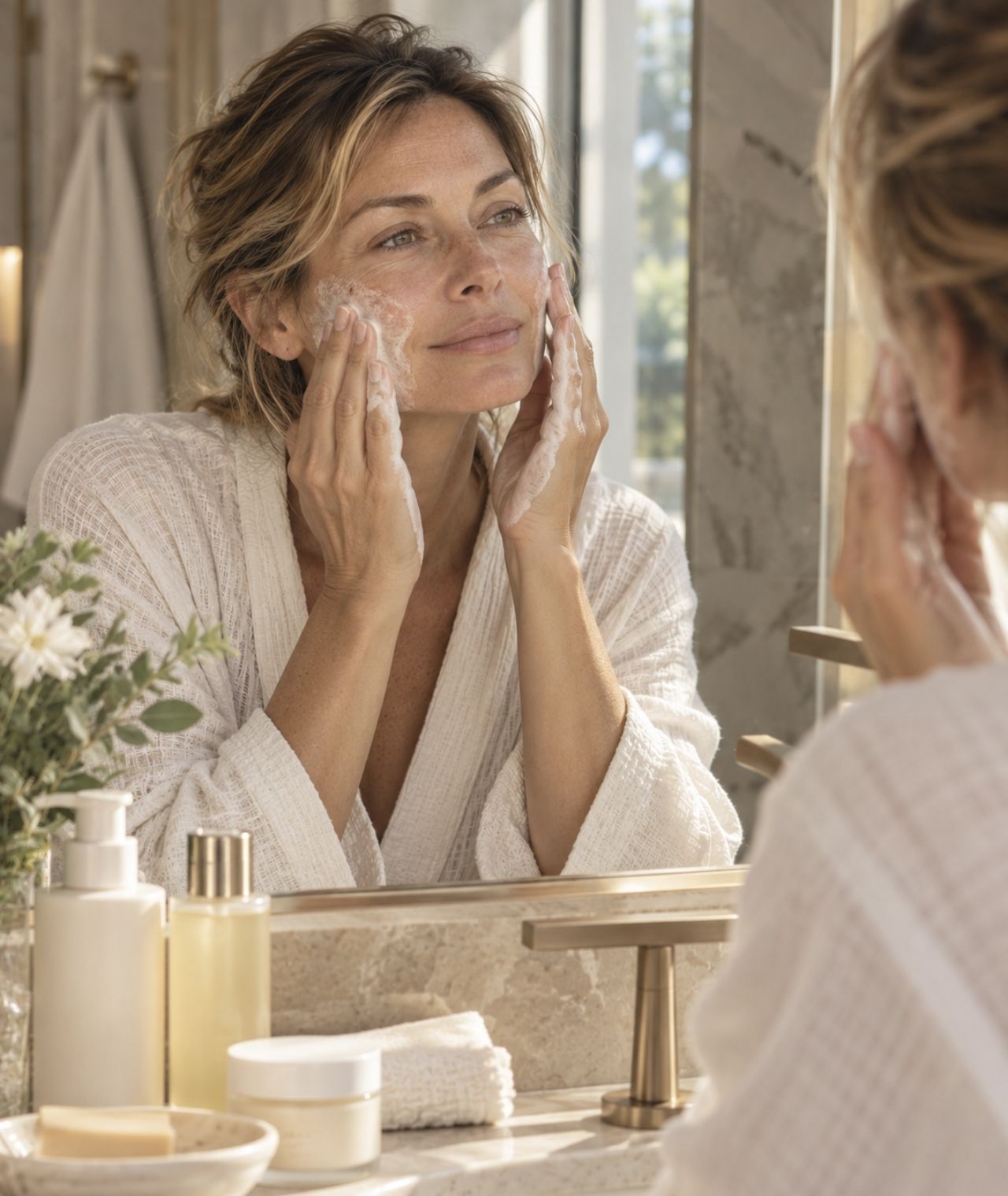
Repairing the barrier first: gentle cleansing, a start that isn't rushed.
3 · Restore the Moisture
Once the barrier has calmed down, it's time to restore the moisture the skin has lost.
There's an important distinction here: moisture and oil are not the same thing. Moisture relates to the skin's capacity to hold water; oil is the protective layer that prevents that moisture from evaporating. After summer, skin is usually lacking in both.
Three groups of ingredients play a functional role in restoring this balance:
Humectants: These draw water from the air and from the skin's lower layers up to the surface, increasing moisture levels. Hyaluronic acid and glycerin are well-known examples of this group.
Ceramides: One of the skin's natural building blocks; they can be thought of as the "mortar between the bricks" of the barrier, and play a role in slowing moisture loss.
Supporting ingredients: Ingredients like panthenol and squalane can offer both a soothing and a light occlusive effect, helping to keep moisture at the surface.
Whether a moisturiser is "light" or "rich" depends on a person's skin type and the season. In September, the aim isn't to choose the heaviest formula, but to find the texture that suits what the skin needs right now.
A Tip from Zarif Yaşam: Applying moisturiser while the skin is still slightly damp — a few minutes after washing the face — is a simple habit that can help the ingredients work more effectively.
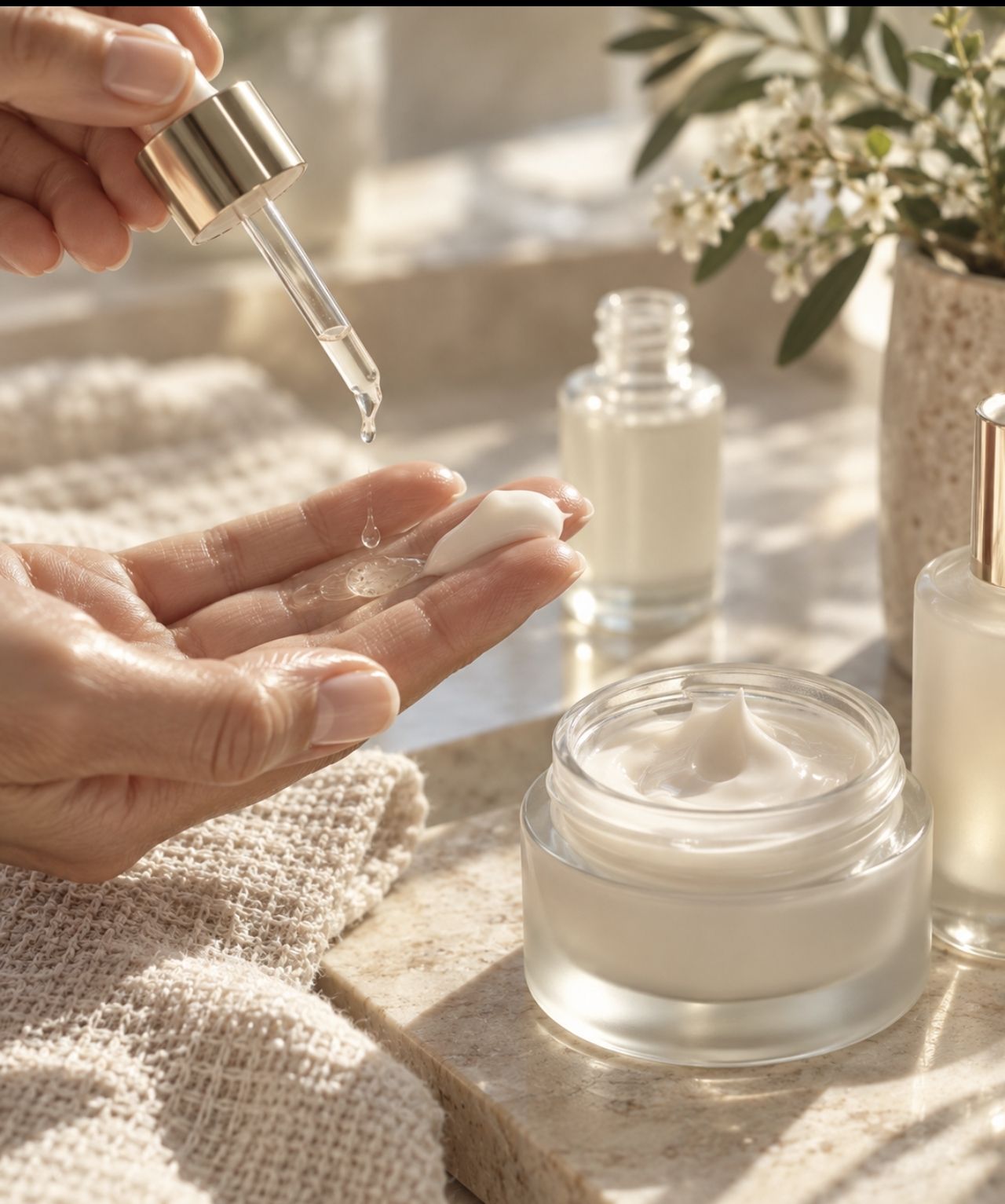
Restoring the moisture: the texture of a serum and moisturiser, a simple editorial frame.
4 · Don't Assume the Sun Is Done
Even though summer closes on the calendar, ultraviolet rays don't disappear in September.
A cloudy sky or cooler air doesn't mean the effect of UV rays has diminished. Time spent outdoors, especially around midday, remains an important factor in uneven skin tone and premature ageing.
This is why giving up sun protection in September can mean leaving skin that's trying to repair itself open to exactly the same fatigue all over again.
A broad-spectrum sunscreen added to the daily routine should be thought of not as an optional step in morning skincare, but as an essential one — even if sun exposure isn't as intense as it was in summer.
Not protecting the skin from the sun while it's trying to heal is a bit like leaving a healing wound open again.

September morning sunscreen: in soft light, a complementary step.
5 · How to Approach Summer's Sun Spots
The uneven tone and spots commonly seen on skin after summer are, more often than not, a result of sun-related increases in melanin.
The most common mistake here is acting too hastily. Wanting to "get rid of" a spot immediately and using several aggressive products at once can strain the barrier, and can sometimes even lead to a new discolouration caused by irritation.
A controlled approach generally includes:
— Priority goes to sun protection; an unprotected spot can keep darkening no matter how much care is applied elsewhere.
— Tone-evening ingredients, such as niacinamide, can make a difference over time when used gradually and regularly; expecting an instant fix isn't realistic.
— For spots that appear deep or persistent, at-home care has its limits; at this point, consulting a dermatologist is the right step.
Skin spots are a bit like weeds in a garden: they're reduced not by pulling at them hastily, but with patience and the right method.

Real skin, up close: not exaggerated, just as it is.
6 · Time to Return to Actives
Once the barrier has settled and the skin's moisture balance has been restored, September is also a good time for a gradual return to active ingredients.
Vitamin C, niacinamide, retinoids and various acids are among the most talked-about ingredients in skincare. But adding all of them at once, at high strength, usually produces the opposite of the intended result.
A few simple principles help with a gradual return:
— Add one new thing at a time. Keeping everything else steady while introducing a new active lets you see the skin's response more clearly.
— Start with low frequency. Using something a few times a week can be a safer starting point for the skin to adjust than daily use.
— Pay attention to combinations. Certain actives can increase the risk of irritation when used together; it's worth knowing which ingredients can share the same routine.
Active ingredients aren't skincare's accelerators — they're partners that deliver results when used with patience.
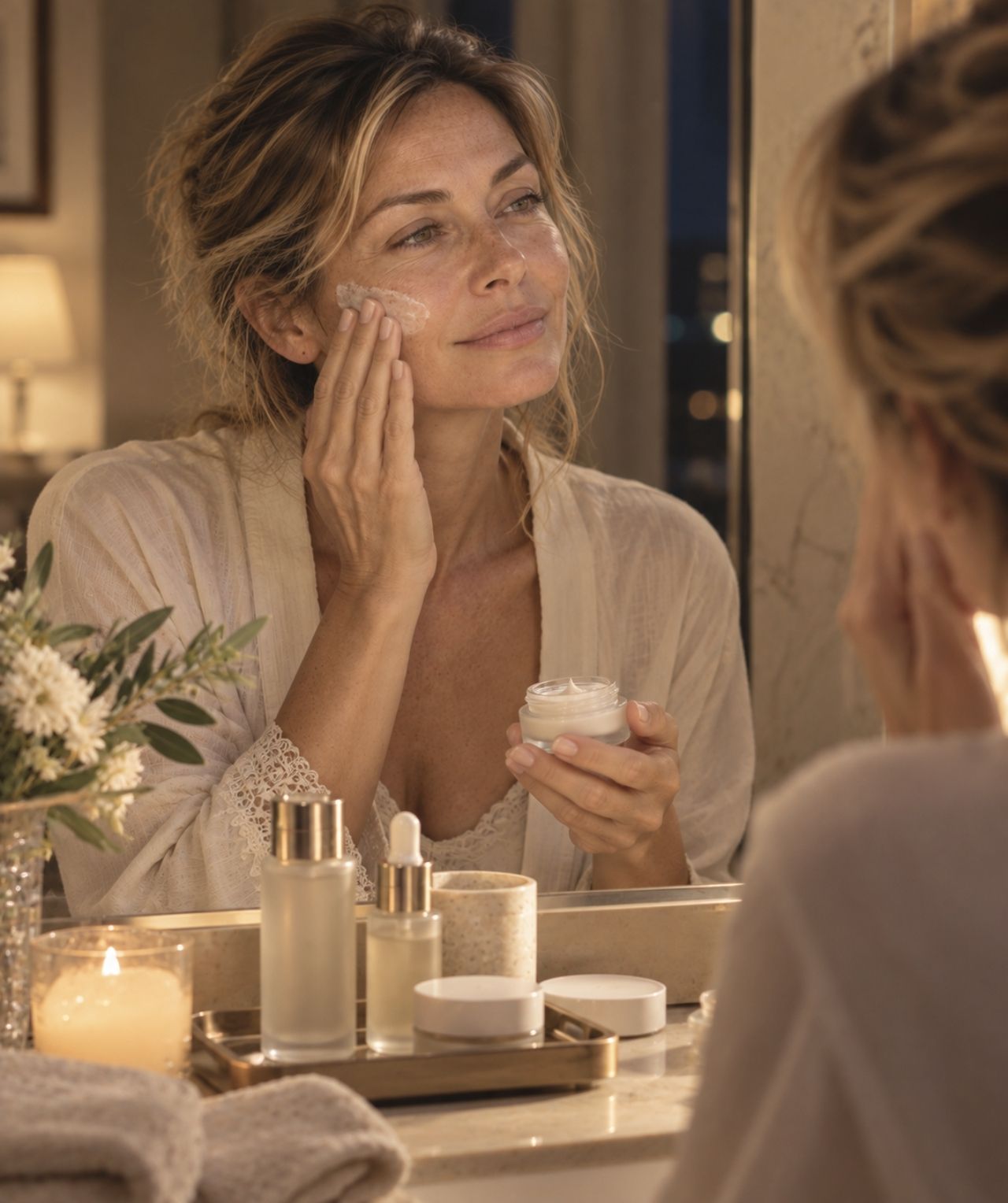
The evening skincare ritual: at the end of the day, calm and unhurried.
7 · Don't Forget the Eyes, Neck and Décolletage
When skincare comes up in conversation, attention usually turns to the face. Yet there are areas exposed to just as much sun as the face — and often thinner and more delicate — the eye area, the neck, and the décolletage.
The skin in these areas is thinner and has fewer oil glands, which makes it more vulnerable to dryness and early signs of ageing. These areas, which are usually given less protection than the face over the summer, absolutely need to be included in September's repair routine.
There's no need for a complicated additional routine; it's often enough to extend the moisturiser and sunscreen used on the face down to the neck and décolletage. For the eye area, a gentle application that doesn't require tugging is preferable.
Elegance is in the detail here too: the care given to the areas we tend to overlook completes the overall picture.

The neck and décolletage: easily overlooked, but never neglected.
8 · Autumn's Start as a Time for Professional Care
At-home care is usually enough. But in certain cases, professional support allows the process to proceed both more safely and more effectively.
Because early autumn is a period of relatively reduced sun exposure, it's also often a preferred time for certain clinical treatments such as peels and laser procedures. But which treatment suits which skin concern, and how often it can be applied, varies from person to person — and this assessment can only be made by a dermatologist.
It's important to distinguish between at-home care and clinical treatments:
— At-home care: Covers daily cleansing, moisturising, sun protection and the gradual use of actives.
— Clinical treatments: Additional support, planned with expert assessment, for deeper or more persistent concerns.
Neither replaces the other; the two complement one another.
If there's something about your skin that concerns you, that isn't improving with at-home care, or that's changing over time, having it assessed by a dermatologist is always the right step.

Expert assessment first: a calm, reassuring clinical atmosphere.
9 · The 21-Day September Skin Reset
The simplest way to bring the information in this section into daily life is to build an uncomplicated rhythm.
The example below is not a prescription; it's a framework for how a three-week recovery process might be structured.
Week 1 — Calm
Morning: Gentle cleansing → Light moisturiser → Sunscreen.
Evening: Gentle cleansing → A repairing/soothing cream.
Active ingredients are paused this week; the aim is simply to calm the barrier.
Week 2 — Restore the Moisture
Morning: Cleansing → A humectant-based serum → Moisturiser → Sunscreen.
Evening: Cleansing → A ceramide-based cream.
If the skin feels comfortable, a single mild active — for example, a low dose of niacinamide — can be tried midway through the week.
Week 3 — Gradual Return
Morning: Cleansing → Vitamin C (if the skin tolerates it) → Moisturiser → Sunscreen.
Evening: Cleansing → One chosen active (a retinoid or acid, 2–3 times a week) → Moisturiser.
By the end of three weeks, the aim isn't flawless skin — it's skin that has returned to balance. From here, the routine can be gradually expanded according to how the skin responds.
This is not a fixed prescription; skin type, sensitivity and the products used vary from person to person. This example has been prepared solely to show how a gradual recovery might be structured.
A Note from Zarif Yaşam
Approaching the skin without rushing in September is, in many ways, a continuation of the patience we've shown it all summer.
There's a question worth asking before adding a new product:
Is my skin genuinely ready for this right now, or am I simply the one in a hurry?
Good skincare comes not from a great many steps, but from taking the right step at the right time.
"Caring for the skin is like living well: it is built with patience, not haste." — Zarif Yaşam

Final: rested, natural, quietly repaired skin.
Editorial Health Note
This content has been prepared for general informational purposes and does not replace personal dermatological assessment. Those with sensitive, allergy-prone or specific skin conditions, who are pregnant or breastfeeding, or who take regular medication, are advised to consult a dermatologist before adding a new product or active ingredient.